Cape Town CBD
Busy and mostly safe by day
7/10
Best times
Mornings, lunch, and early evenings on main streets.
Local tip
Walk around the Company’s Garden and Long Street during daylight, but avoid the station precinct and Darling Street after dark.
Most days, yes, especially in the tourist core and along the Atlantic Seaboard. But safety in Cape Town is block-by-block, not city-wide. The real risks are petty theft, opportunistic phone snatching, and driving into the wrong area after dark. This guide is written by someone who lives and drives here, and it is current for 2026.
By Daniël van Wyk. Cape Town resident and daily driver, writing since 2019. Last updated 15 September 2026.
Cape Town is safe for most visitors who stay in the CBD, V&A Waterfront, Sea Point, Camps Bay and the Southern Suburbs, keep valuables out of sight, and avoid unfamiliar areas after dark. Petty theft and phone snatching are the common risks, not violent crime against tourists.
Eleven areas visitors actually use, colour-coded by how comfortable they are on foot. Positions are relative, so use it to understand which areas sit next to which, not to navigate.
Ratings reflect the author's own experience of walking and driving these areas, not police crime statistics.
Safety changes from one neighbourhood to the next. Here is a practical breakdown based on daily life in the city.
Busy and mostly safe by day
Best times
Mornings, lunch, and early evenings on main streets.
Local tip
Walk around the Company’s Garden and Long Street during daylight, but avoid the station precinct and Darling Street after dark.
One of the safest areas
Best times
Sunrise to late evening, when the promenade is busy.
Local tip
Main Road is well-trafficked and well-lit. Stick to the promenade at night only if there are other people around.
Safe, with high visibility
Best times
Late afternoon through evening when the strip is active.
Local tip
Parking on side streets can be targeted. Pay the car guard and do not leave bags visible on the seat.
Calm and residential
Best times
Daytime and weekday mornings.
Local tip
Keep windows up and doors locked at intersections. Watch for smash-and-grab hotspots near traffic lights.
Safe if you stay on the route
Best times
Daylight, before and after peak traffic.
Local tip
Do not stop for strangers on the N2. Use the official airport taxi rank or a verified Uber from the pickup zone.
High risk without a local guide
Best times
Avoid after dark; only visit with trusted locals.
Local tip
Steer clear of Nyanga, Khayelitsha, Manenberg, and parts of Mitchells Plain unless you are with a local who knows the area.
The context matters as much as the neighbourhood. A few street-smart habits make a noticeable difference.
Stick to busy, well-lit streets. Avoid shortcuts through parks or empty parking lots. Keep your phone in your pocket and walk with purpose.
Use a GPS route that avoids informal settlements. Keep doors locked, windows up in slow traffic, and bags out of sight. Night driving on rural roads needs extra caution.
Uber is widely used and generally safer than hailing a taxi. Check the plate and driver name before getting in, and share your trip with someone.
Start early, take a map or offline route, and hike with at least one other person. Platteklip Gorge and Skeleton Gorge are popular; tell someone your planned return time.
Use ATMs inside banks or shopping malls. Ignore strangers offering to help at the machine. Card skimming still happens at unattended outdoor ATMs.
Save these to your phone before you land. Mobile data is unreliable on the mountain and in parts of the peninsula.
Works on every South African mobile network, also with no airtime, and routes you to an emergency operator.
The national police emergency line. Ask for the case number before you hang up.
National emergency medical services and fire.
The city's own control room for fire, metro police, traffic and ambulance inside Cape Town. Dial 107 from a landline, or 021 480 7700 from a mobile.
Wilderness Search and Rescue and the Metro Rescue control centre, for hikers and climbers in trouble on Table Mountain, Lion's Head and around the peninsula coastline.
The park's own hotline for emergencies and incidents inside Table Mountain National Park.
Six steps, in order. Step four is the one people forget, and it is the one every insurer asks for.
Almost every street robbery in Cape Town is about the phone, the bag or the watch. Give it up. Resisting is what turns a theft into an assault.
Move to a shop, hotel, petrol station or restaurant before you stop to deal with anything. Call 10111, or 112 from a mobile if you cannot get through.
Report at the police station closest to where it happened. In the city centre that is Cape Town Central SAPS in Buitenkant Street; the Waterfront, Sea Point, Camps Bay, Woodstock and Muizenberg all have their own stations. Take your passport if you still have it.
A case number, often called a CAS number, is the reference SAPS assigns to your docket. Write it down along with the name and rank of the officer. No insurer, phone network or embassy will process a claim or a replacement document without it.
Call your bank's 24 hour lost card line, block your SIM with your network, and use Find My iPhone or Find My Device to erase the phone remotely. Do not go to the phone's last known location yourself.
For a stolen passport you need the SAPS case number plus a police affidavit before your consulate in Cape Town will issue an emergency travel document.
These are the six that come up again and again, by name, so you recognise the setup while it is happening.
Someone distracts you at the machine, taps the keypad so the card is retained, then hands back a similar-looking card that is not yours. Never let anyone touch the machine with you. If the ATM keeps your card, stay at the machine and call your bank before you walk away.
A friendly person offers to help with an error message or a foreign card. They are watching your PIN. Cancel the transaction, walk away, and use an ATM inside a bank branch or a mall during trading hours.
Skimmers appear on unattended outdoor ATMs and at petrol station card machines. Cover the keypad with your hand, keep the card in sight, and check that the card slot does not move when you tug it.
Real car guards in the city and at the beaches wear a numbered bib from the parking marshal scheme. Freelancers demand money up front and disappear. Pay 5 to 10 rand at the end, not before, and never hand over your keys.
Drivers touting inside the terminal will quote several times the going rate for the 20 kilometre run into the city. Use the metered taxi rank outside the terminal building, or book Uber or Bolt and walk to the signposted e-hailing pickup zone.
Two variants: a stranger flags you down on a quiet road, or you find your tyre mysteriously flat in a parking lot and someone appears to help. Drive to a petrol station before you stop, and phone your rental company or roadside assistance.
The habits locals do without thinking, written down with actual numbers attached.
Enough for car guards, tips, parking and a taxi, little enough that losing it does not ruin the day. Leave the rest, plus one backup card, in the hotel safe. Split cash between two pockets.
Smash-and-grab happens at red lights in slow traffic. Put bags, phones and laptops in the boot before you set off, not at the light. Leave one car length in front of you so you can pull out.
Not a jacket, not a charging cable, not an empty bag. Boot-and-run break-ins at trailheads and beach car parks are opportunistic.
Three people means one can stay with an injured person while another goes for help. Start early for the heat, the wind and the light, and be off the mountain well before sunset. Tell someone your route and your expected return time.
Platteklip Gorge, the Pipe Track and the Lion's Head spiral carry steady foot traffic all day. Quieter routes on the slopes above the city and around the eastern side of the mountain have a longer history of muggings, which is why SANParks and local hiking clubs advise groups and daylight hours there.
Walking while looking at a phone is the single most common setup for a snatching in the CBD and along Long Street. Step into a doorway, check the phone, put it away.
A short trip across the City Bowl or from Sea Point to the Waterfront costs less than a drink. Match the plate and the driver's name, sit in the back, and share the trip.
Short, honest answers to the questions people usually ask before they arrive.
Yes, for most tourists. The main areas visitors use, namely the CBD, V&A Waterfront, Sea Point, Camps Bay, and the Southern Suburbs, are relatively safe if you use common sense. Petty theft and phone snatching are the most common issues, not violent crime against tourists.
Driving is generally safe, but the route matters. Main roads and highways are fine by day. Avoid driving through high-crime neighborhoods after dark, keep valuables hidden, and do not stop for strangers on the N2 or at remote traffic lights.
Uber is usually the safest ride option. Verify the driver’s photo, name, and registration plate before entering. Share your trip status with a friend and sit in the back seat.
Most visitors should avoid Nyanga, Khayelitsha, Manenberg, and parts of Mitchells Plain unless they are with a trusted local guide. After dark, be cautious even in the CBD around the station precinct and quieter side streets.
Most visitors should stay out of Nyanga, Khayelitsha, Manenberg, Hanover Park, Lavender Hill and parts of Mitchells Plain unless they are with a local who knows the area, and not after dark. Township visits are worth doing, but book a guided tour with a local operator rather than driving in yourself. In the city centre, the parts to avoid are specific rather than large: the railway station precinct, the Grand Parade and Darling Street after the shops close, and any quiet unlit side street off Long Street or Bree Street late at night.
In a few places, yes. Sea Point Main Road, the Camps Bay strip, Kloof Street, Bree Street and the V&A Waterfront stay busy and lit, and walking short distances between them is normal. Everywhere else, take an Uber or Bolt. Do not walk the Sea Point promenade, the Company's Garden, Signal Hill road or any residential side street after dark, and do not walk between the CBD and Woodstock at night even though it looks close on a map.
The V&A Waterfront is the most heavily secured public space in Cape Town, with its own control room, camera network and visible private security patrols, and it stays busy well into the evening. It is a reasonable place to be on foot at night. The weak points are the car parks and the walk out towards Granger Bay and Mouille Point, where foot traffic drops off quickly; take a car or an Uber for that stretch after dark.
Hiking Table Mountain alone is not recommended, and local hiking clubs and SANParks consistently advise groups. Two risks stack up: muggings on quieter trails, and the fact that a twisted ankle on an empty path with no signal can turn serious fast. Hike in a group of three or more, start before 09:00, stick to busy routes such as Platteklip Gorge, the Pipe Track or the Lion's Head spiral, carry two litres of water and a warm layer, and tell someone your route and return time. Wilderness Search and Rescue is reached on 021 937 0300, and the Table Mountain National Park emergency hotline is 086 110 6417.
Hand over what they want and do not resist. Get to a busy shop, hotel or petrol station, then call 10111, or 112 from a mobile. Report the robbery in person at the nearest SAPS station and insist on a case number, also called a CAS number, because no insurer, mobile network or consulate will replace anything without it. Then block your bank cards and SIM, and erase your phone remotely. Do not go looking for the phone yourself.
It depends on where you are. Sea Point Main Road, Camps Bay, the V&A Waterfront and Kloof Street stay busy and are generally fine on foot until late. The CBD around the station precinct, quiet residential side streets and any unlit area are best avoided on foot after dark. Use Uber or Bolt instead of walking between areas.
Many solo female travellers visit Cape Town without incident. Stay in Sea Point, Green Point, Camps Bay or the City Bowl, use Uber after dark rather than walking, avoid isolated hiking trails alone, and never leave a drink unattended. Book guided tours for townships and remote trails.
Dial 10111 for police and 112 from any mobile phone. For City of Cape Town emergencies, dial 107 from a landline or 021 480 7700 from a mobile. For a hiker in trouble on the mountain, Wilderness Search and Rescue is reached on 021 937 0300, and the Table Mountain National Park emergency hotline is 086 110 6417. Save these before you arrive, since mobile data can be unreliable on the mountain.
Yes during daylight, along the promenade and Beach Road, where there is steady foot traffic. After dark, take an Uber. The stretch past Granger Bay and the Mouille Point car parks gets quiet and is a known spot for phone snatching.
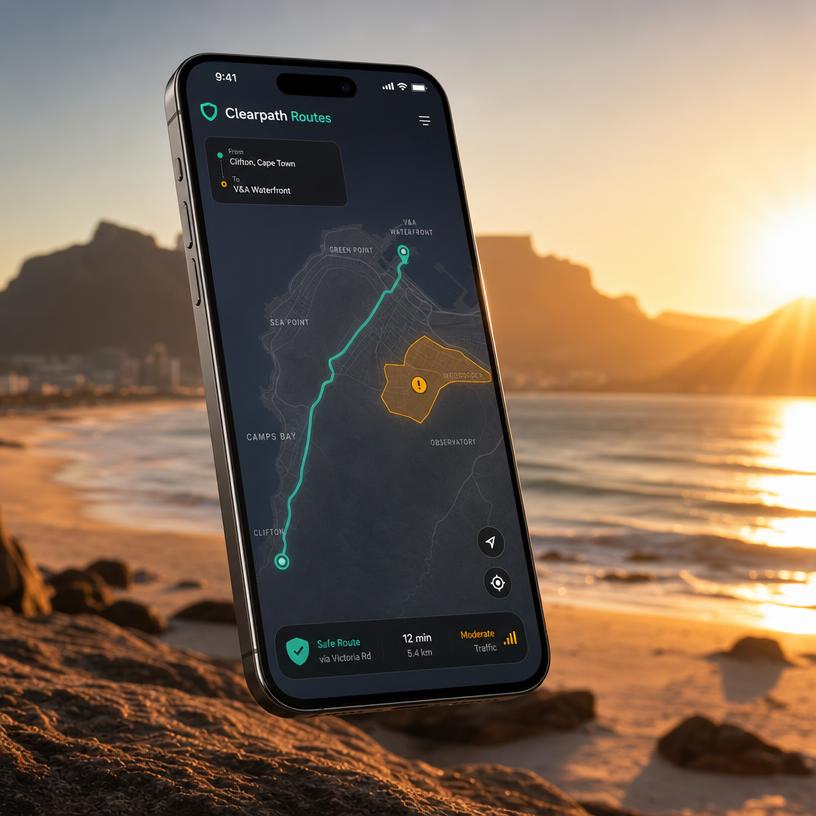
Clearpath Routes is our own Cape Town navigation app. It routes you around the hotspots visitors are usually warned about, highlights danger zones, suggests safer alternatives, and we keep the data current ourselves.
Full disclosure: Clearpath Routes is our own app.